Introduction
Many compliance standards now include requirements for food businesses to demonstrate the development and improvement of their food safety and quality culture. This post explores systemic influences on culture and offers suggestions for how to promote your businesses’ food safety and quality culture through systematic interactions.
Table of Contents
Recruitment and Candidate Selection
The first indication of your organisation’s food safety and quality culture to prospective candidates is the content of job adverts. There’s an opportunity to show how important the candidate’s attitude toward food safety and quality is to their suitability for any role they apply for. It should be clear from the job description and selection criteria what is expected from the successful candidate and what cultural values are significant for success in the role.
At interview, questions posed to candidates should yield insights into their attitude and disposition toward quality and food safety. With interviews being a 2-way process, the interaction should make it obvious to the candidate that food safety and quality is of high importance to the organisation as well as providing assurance to the interviewer that the candidate is a good fit for the organisation’s food safety and quality culture.
It’s important that recruitment and candidate selection prioritises the food safety and quality culture that the organisation is seeking to promote. If an otherwise strong candidate has an attitude or disposition that would be detrimental to the organisation’s food safety and quality culture, then that should disqualify the candidate despite their strengths in other areas.

Performance Assessment and Rewards
Just as the selection process for new employees should emphasise the importance of their attitude and disposition toward food safety and quality, existing employees should have their roles structured around food safety and quality objectives – and that should be reflected in performance assessment and progression opportunities.
For every role in the company, the job description should consider the impact of that role on food safety and quality. For food handlers, there is a clear and direct influence on food safety and quality that can be addressed in detail. For roles with an indirect impact on food safety and quality, the job description presents a useful opportunity to outline the impact of their positions and bring clarity to how their food safety and quality objectives can be met. For example, the Planning Manager has an indirect impact on food safety and quality and the role holder can fulfil their objectives by dedicating sufficient time on the plan to hygiene and maintenance activities.
At performance review and salary increments, the performance of the individual should take into account their attitude, quality of work, results and output, and the extent to which they have met the food safety and quality objectives in their job description. Employees that exemplify the organisation’s food safety and quality ideals should have a genuine opportunity to benefit and progress as a result of their contributions. Employees that do not uphold the company’s food safety and quality ideals should not be rewarded or promoted into more senior positions. The system of incentives should be an effective mechanism for the enforcement of the company’s cultural ideals and should reward positive engagement.
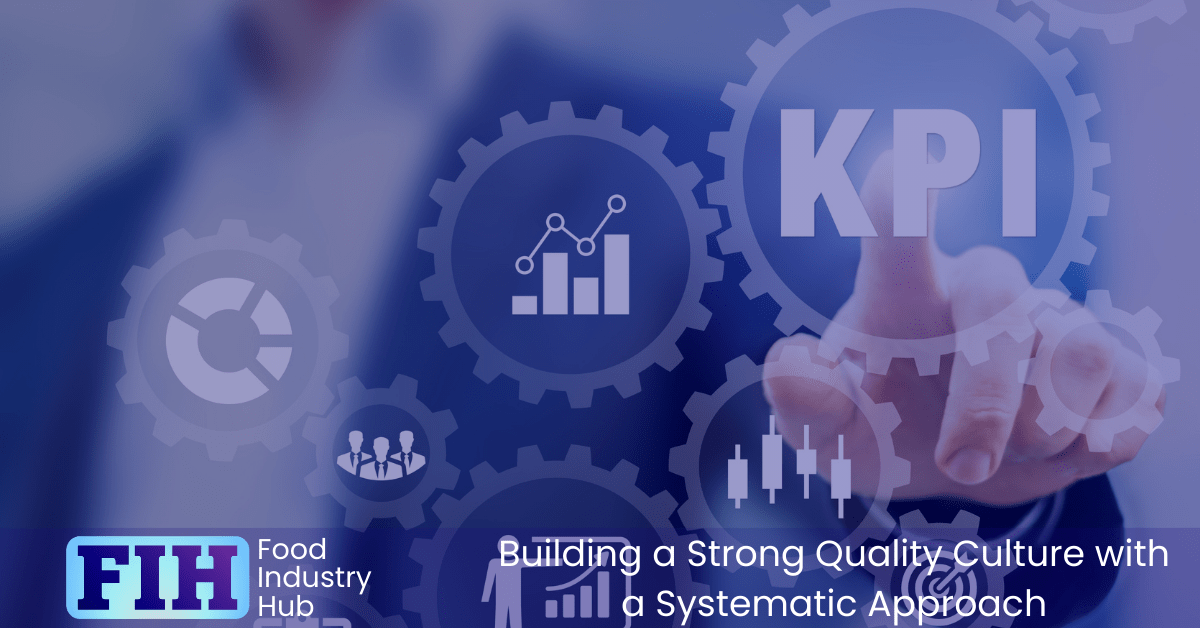
On a team performance level, performance metrics and KPIs can be highly influential of culture and behaviour. The extent to which operational performance is assessed based on quality metrics is an indicator for how much of a priority the business considers those metrics to be and helps employees to orient their efforts and contributions around quality success.
Messaging and Promotion
Continual reinforcement of the company’s values and expectations is an important tool for cultural influence. Messaging should be prominent, easily visible, and easily interpreted by the intended audience. Consideration should be given to the native language of the workforce.
Be mindful of the content of messaging. In general, it is constructive to think in terms of the values being promoted, and specific actions that you would like they audience to take as a result of the influence of the messaging.
From a systems point of view, the principal of using ‘touch points’ to reinforce a message can be very effectively applied when each interaction employees have with the quality management system is treated as a messaging opportunity. For example, process records/check sheets used in production aren’t just a one-way means of collecting information – messaging such as “If you’re unsure, it’s always better to put stock on hold than dispatch potentially defective product to customers,” can be presented on process record sheets as a permanent reminder of the quality disposition the company would like to promote.
Using posters and other artefacts to promote quality messaging is good and constructive, but the real value comes from establishing the relevancy of the messaging to the role of the audience. A poster that reads “Quality starts with YOU!” can communicate a positive quality sentiment, while targeted/instructional messaging delivered at the point of use with direct applicability to the intended audience will be far more powerful.
Sign up for the Food Industry Hub Mail Service
Receive Food Industry Hub updates, resources, articles, tools and service developments direct to your inbox.
Each update helps you stay connected with new and relevant Food Industry Hub content, with links back to resources you may want to read, use or revisit.
Values and Consistency
Any inconsistency or contradiction in the values expressed by the organisation or its management can undermine your efforts to shape the food safety and quality culture.
The classic example here is the apparent conflict of interests between the production department and the quality department. Traditionally, one has been motivated to optimise for output volume at the expense of equality, while the other has been motivated to control for quality at the expense of output volume. A poster on the wall might proclaim “Quality is our top priority”, but it will seem empty and irrelevant if conflicting values and motivations are allowed to win out.
The more consistently you can align everyone’s values and motivations, the more successfully a unified food safety and quality culture can be underpinned. Ideally, the production department is motivated to produce the maximum volume possible without compromising on quality – just as the quality motivation should be to promote quality safeguarding while supporting the production objectives. Mutual alignment across all departments and organisational tiers has the result of reducing conflicts of interest as well as promoting cooperation and teamwork, so this is an important area to address.

Leadership Engagement
Senior management exert an enormous influence over the values of an organisation. Commercial success is critical to the continued operation of a business, and the degree of importance senior managers can appear to place on commercial performance can sometimes make it appear that it is their only concern – above all other considerations.
From the point of view of someone on the factory floor, it might be easy to believe the only priority of the senior management is profit and loss – especially if the only times top level management appear to show an interest in operations is at the acquisition of a high-profile customer or following unplanned downtime in the factory.
In the same way that cultural success depends on alignment and consistency throughout different departments and functions, it’s really important that all management tiers demonstrate engagement and prioritisation of food safety and quality concerns. Cultural change isn’t necessarily top-down or bottom-up, it actually depends on a consistent alignment of values at all organisational levels.

Training and Development
It’s obvious that if you want to empower an individual to be competent and effective in their role, you should provide training and development opportunities so that they can gain skills and capabilities that better enable them to perform their duties. Committing resources to personal development plans is clear demonstration of the expectations of the role, and once training has been provided the individual becomes accountable for delivering on those expectations.
For the same reasons, it is highly beneficial to invest in training and development activities that empower employees to deliver on food safety and quality objectives. Not only will they be more effective in delivering results, but they will be individually accountable for the way they perform following the training.
It is conventional to issue food hygiene and allergen management training to food handlers, but there is far greater potential to use training for cultural impact. The engineering team may benefit from training on foreign body control and environmental hygiene, for example.
As another consideration, it can often be the case that the individuals who make up the management team at food businesses have been promoted into those positions without ever receiving leadership and management training. It seems intuitive that the site management will be better placed to positively shape the company’s culture if they are given training and skills development in that function.

Transparency and Agenda
‘Transparency of quality performance’ can often just mean putting up a report in the factory that details the most recent customer complaints or GMP audit results. Making these things visible and available to all employees is constructive because it illustrates the importance of operational and quality performance…. But there is far greater opportunity to be transparent with food safety and quality information.
Quality review meetings attended by the senior management can have minutes recorded and distributed to all employees including factory floor workers. The actual conversation topics discussed can be reviewed by all workers – so the sentiments of the highest-level managers and directors are accessible throughout the business. The attitudes expressed and questions asked have a real significance.
To illustrate, the Managing Director of a food business might attend regular quality review meetings and show an attentive interest in quality performance and ask targeted questions throughout the meeting, allocating extra resources as required. The personal engagement and values expressed can be transformative in the perception of anyone who has been given the opportunity to attend the meeting, and the same benefits can be experienced by anyone provided with the meeting agenda and minutes. Giving all employees the opportunity to read the minutes from meetings like this doesn’t only enable the senior management to authentically express their values and priorities – this degree of openness really serves to foster an environment of inclusivity and engagement.
Eliminate Blame
Focus on the incident, not the individual. A blame culture is entirely incompatible with a positive quality culture because there is an inherent tendency toward disciplinaries and punishment – which rarely serves to address systematic faults or prevent recurrence.
The way to systematically eliminate a blame culture from your business is to treat the identity of any individuals as confidential/sensitive across all management tiers. For example, if an operator is seen licking their fingers to make it easier to open the food contact plastic bags at packing, disclosing the identity of the individual who was seen doing it is likely to steer investigation responses toward disciplinary procedures and away from the systematic problem that operators are finding it difficult to open the plastic bags with dry fingers. Focussing on the incident would result in the investigation introducing a hygienic method for the operators to carry out the activity, while persecuting the individual allows the original problem to persist.
On a practical basis, this can be brought into effect by incorporating the principal of confidentiality into the site’s quality policy – signed and committed to by the senior management. As a matter of policy, individuals’ identities shall not be disclosed unless the investigation specifically concludes that individual misconduct or negligence was the root cause of an incident. Under all other circumstances, investigations shall be based on the event that occurred and not the specific individual involved.
You can’t have a blame culture if you don’t target an individual to blame, so this may be among the most effective and easily implemented cultural changes you can introduce.
In Summary
Developments to food safety and quality culture for food business operators can seem nebulous because ‘culture’ is such an intangible subject. ‘Culture’ is generally thought of as ‘shared values, beliefs, and motivations’ – and the task of influencing shared values, beliefs, and motivations can be pretty daunting!
By incorporating cultural factors into systematic processes, businesses can introduce a framework of motivations and enforcement that will shift the culture in a considered direction in a very intentional way. The influences that act on individuals, departments, functions and managerial tiers should be strategically aligned to result in a predetermined set of cultural values.
It takes time and commitment to exert cultural change, but with the right inputs the results can by systematised just like any other business function.
If you apply the principals in this article, you can create an environment where…
○ New employees are recruited based in part on their quality and food safety attitude and disposition.
○ Existing employees are motivated and rewarded in line with the organisation’s quality values.
○ The company’s disposition toward quality and food safety is continually reinforced through targeted and relevant messaging.
○ Cross-functional values and motivations are aligned toward a unified quality objective.
○ Leadership engagement is clearly demonstrated and apparent.
○ Training and skills development is utilised for overall quality performance.
○ Transparency of mission, and leadership sentiment are cascaded throughout the organisation – fostering inclusive engagement.
○ A blame culture is not possible because of the way investigation data is handled.

From The Food Industry Hub Knowledge Centre
Featured pages from The Food Industry Hub Knowledge Centre:
Further Resources
Food Industry Hub serves the food industry with a range of digital resources for the benefit of both commercial food manufacturers and food industry professionals.
For food manufacturers, we offer integrated management systems that give every user a direct interface with your QMS.
For food industry professionals, we provide an extensive signposting service in addition to informational content we hope you’ll find useful as you face new professional challenges. We have very ambitious plans to expand the range of services offered, and currently present informational content on management, safety and quality, and professional success.