Introduction
The highest responsibility of any food manufacturer is to uphold the safety, authenticity, legality, and quality of its products. This is fundamental to fulfilling the expectations of customers and consumers.
To this end, food manufacturers should set clear objectives to maintain and improve assurance process is and quality outcomes.
These objectives should be measurable and ‘smart’ in order to promote success in maintaining or improving product safety, authenticity, and legality. This article will provide an overview of how setting objectives can help food manufacturers to achieve optimal standards for their products and processes.
Table of Contents
Key Takeaways
- Defined objectives set expectations for improvements to the product safety, authenticity, legality, and quality.
- SMART objectives are specific, measurable, achievable, relevant, and time-bound – so objectives should be rooted in performance metrics.
- The success or failure of a food business in meeting its objectives should inform future actions as a result of root cause analysis.

The Expectation of Ongoing Improvement of the Product Safety, Authenticity, Legality, and Quality of Products in Food Manufacturing
Food manufacturers must establish clear goals to ensure that the production process conforms to regulatory requirements on product safety and legality. Objectives should be measurable standards set by the manufacturer to guarantee that each product meets specific quality and safety standards.
There is a clear expectation of continual improvement in food manufacturing – held by customers, compliance and assurance scheme operators, and the wider market. All food manufacturers should have a robust vision for their business and how it will be managed. The vision should be shared by all members of staff to ensure that everyone knows what the company is striving for. Ensuring ongoing improvements to product safety, authenticity, legality, and quality requires consistent effort and investment on a manufacturer’s part. Continuous improvement is essential for food manufacturers since it helps them remain competitive while meeting regulatory requirements at all stages of operations.
Setting measurable objectives and demonstrating improvement depends on applying performance indicators to different risk factors and their control systems. In other words, objectives should not be rooted in vague aspirations such as ‘quality should improve year on year’ – but should be rooted in the improvement of objective indicators for Product Safety, authenticity, legality, and quality standards.

Identifying Performance Metrics That Can Be Applied to Product Safety
Product safety metrics measure the potential for harm caused by introducing products onto the market. In general, product safety hazards can be categorised as physical, chemical, microbiological (pathogenic), and allergenic – so product safety metrics should report the effectiveness of – and adherence to – control systems intended to mitigate these risks, as well as any hazards that persist in the product after processing.
For example, food manufacturers may choose to use a metric that assesses the effectiveness of the company’s sterilisation process, or one that measures the incidence of pathogenic bacteria present in batches produced. Similarly, the critical limits for a metal detector, the frequency of identification of contamination, and incidence of metal foreign body complaints can be taken in concert to indicate product safety performance specific to metal foreign body risks.
Product and process safety determination can be expressed both qualitatively and quantitively on the basis of likelihood of risk (of harm), along with the severity of outcome anticipated. In other words, a product or process might be considered to be reliably safe, extremely unsafe, or any intermediate level of risk. The applicable objectives introduced by the business should target a measurable improvement in the product safety performance Indicated by metrics for as comprehensive arrange of food safety risks as possible.

Sign up for the Food Industry Hub Mail Service
Receive Food Industry Hub updates, resources, articles, tools and service developments direct to your inbox.
Each update helps you stay connected with new and relevant Food Industry Hub content, with links back to resources you may want to read, use or revisit.
Performance Metrics for Product Authenticity
Authenticity metrics measure the success or failure of processes and controls intended to safeguard authenticity and integrity, as well as the actual authenticity of products manufactured. Product integrity is usually binary in nature – so a product is either authentic or it isn’t.
For example, traceability systems must be able to trace distinct lots from raw material intake through processing and dispatch of finished product batches, and any loss of traceability would present a failure of quality assurance systems to substantiate product authenticity. Analytical testing applied to raw materials or finished products will either confirm or refute product authenticity.
With this in mind, quantitative performance reporting should be based on a pass rate or failure rate over a specified sample size (time period, number of batches, instances of a process being undertaken, etc).
Food products can be said to be authentic when they satisfy all expectations that a customer or consumer might have as a result of claims or messaging by the seller. In other words, any expectations of the food arising from the specification, pack copy, advertising and marketing, or implicit market standards (e.g. The name of the food) must be met in order for the food to be regarded as authentic.
Objectives for food authenticity metrics may be rooted in strengthening assurance systems designed to protect and promote food authenticity or may target an improvement in the rate of authenticity of products released onto the market. In either case, the objectives should ideally demonstrate a measurable improvement in product authenticity or a reduction of the risk of inauthenticity.

Performance Metrics for Product Legality
Just as with product authenticity, legality of products and processing conditions is normally binary. ‘Legal’ and ‘illegal’ are not usually found on a sliding scale. To illustrate, ingredients were either held within their legally prescribed temperature range (according to applicable holding periods) or they were not. Additives and processing aids were used either within, or in excess of, legal limits. The x-height of text displaying mandatory particulars on a product label meets the minimum legal requirement, or it does not.
The success rate for legal compliance, then, must be used as an objective performance metric – rather than the degree to which compliance with the law is achieved.
Alternatively, interventions for legal compliance may be used as the basis for improvement objectives. For example, an increase in the frequency at which applicable laws and regulations are reviewed by the food manufacturer could be used as a performance objective for legal compliance.
Also, allocation of resources for the purpose of legal compliance could be increased as part of the company’s legal objectives. For instance, a food manufacturer might set an objective to engage with a legal advisory service such as Campden BRI within a specified time frame as one of its objectives for legal compliance.

Performance Metrics for Product Quality
For the purpose of performance monitoring and objectives, ‘quality’ can refer to ‘fitness/suitability’ and ‘attainment of standards’.
‘Fitness and suitability’ apply to all processes that align quality expectations/standards with the need or requirement being addressed. For example, if the NPD process generates a product that results in poor sales because there is no alignment between the intended properties of the product and the characteristics sought by the target market, the quality of the product can be said to be unsuitable – even if it is manufactured perfectly. As another example, if the quality attribute sheet (QAS) for a particular stock keeping unit (SKU) fails to define an important characteristic or defect, then there is a fitness/suitability defect that applies to the QAS – independent of the actual standards seen in the manufactured product.
‘Attainment of standards’ refers to the success or failure of a product or process in meeting its predetermined attributes. This is an important concept because, if a product or process meets the quality characteristics that were planned for it, then it can be said to have achieved the standards and would not be defective in this respect. A product might be subjectively unappealing, but still be considered an ideal example of a manufactured unit – provided the characteristics are consistent with the QAS.
On an objective basis, quality is satisfactory when the characteristics of a product or process are well-suited for the intended use (fitness for purpose), and when deviations are controlled such that predetermined expectations are met.
Performance metrics for quality should ideally target both ‘fitness and suitability’ and ‘attainment of standards’.

Defining Current Performance and Selection of Improvement Objectives
Defining the current performance of a food manufacturing system is the first step in developing objectives for improvement. This entails identifying any existing safety, authenticity, legality, or quality issues within the production process. Once these issues have been identified and assessed, specific improvement objectives can be set to address them. For example, if there are concerns about product safety in a particular area of the manufacturing process, an objective could be to implement new safety protocols or training initiatives – specific to the particular concerns noted.
Selection of improvement objectives should prioritise addressing critical issues that pose a significant risk to product safety or quality. Improvement objectives should also be realistic and achievable within a reasonable timeframe.
Defining current performance is necessary for both establishing improvement objectives and substantiating whether improvement is achieved.

Cost:Benefit Ratio for Improvement Initiatives, and Prioritisation of Objectives
It is important to consider the cost:benefit ratio of any initiative. The cost of each initiative taken should be weighed against its potential benefits. The objective is not just to improve product quality but also to optimise quality gains relative to outlay of resources.
An assessment of anticipated performance gains against the time required to implement change, as well as any costs associated (including opportunity cost), allows food manufacturers to prioritise the implementation of projects that will yield the best return, in the shortest time, and with the greatest efficiency. The objectives set (and associated timeframes) should result from this assessment.
If a food manufacturer identifies several areas that need improvement such as sanitation practices and employee training, they must prioritise which areas require immediate attention in the context of time and resources available, competing objectives, anticipated gain or payoff, risks associated with de-prioritisation (or delay), and the overall significance of the area for improvement.
Determining Success Criteria and Evaluating Outcomes
Applying objective performance metrics to safety, authenticity, legality, and quality has the practical advantage of facilitating success/failure determinations. Have objectives been met based on predetermined performance criteria, or not?
Success or failure can be measured through a variety of methods including audits, customer feedback, analysis of process standardisation/deviation, and product testing. If any issues or areas for improvement are identified during these evaluations, corrective actions should be taken to prevent further risks.
Ideally, a variety of real-time and lagging performance indicators should be established at the point when objectives are defined. For example, a robust system of objectives and performance measuring might put forward quality objectives rooted in an assessment of the suitability of products and processes, real-time monitoring of process performance, and lagging indicators such as feedback in the form of customer complaints. By comparison, a quality objective such as ‘<1.7 complaints per million units (CPMU) reported quarterly’ could be considered underdeveloped.
Reporting and Communicating Progress Against the Product Safety, Authenticity, Legality, and Quality Objectives
Reporting and communicating progress against the product safety, authenticity, legality, and quality objectives is important for accountability and stakeholder awareness. The primary objective of reporting is to provide stakeholders with information on the company’s performance regarding product safety, authenticity, legality, and quality. This information helps them assess whether the company has met its goals or not.
One way companies report progress is by creating a dashboard that shows key performance indicators (KPIs) for each objective. This dashboard can include data such as compliance rate with regulatory standards, number of product recalls due to safety concerns or counterfeiting, outcomes from taste panels, and any issues detected during audits.
Another way companies communicate progress is through regular meetings with stakeholders where they share updates on their achievements towards meeting their objectives. Companies can also create annual reports that detail their progress toward each objective over time, highlighting successes and areas for improvement.
Maintaining transparency about these objectives helps build trust among stakeholders while providing accountability for achieving set goals.

Applying Root Cause Analysis to Failed Objectives for Performance Improvement
Root cause analysis is a powerful technique that can be used to identify the underlying causes of failed objectives for performance improvement. When objectives are not met, it can lead to serious consequences such as health risks for consumers or legal issues for the company.
The management team can use various tools such as fishbone diagrams or 5 whys techniques to determine what led up to the failure to meet a defined objective. By identifying all contributing factors and addressing them accordingly, companies can improve their overall performance in maintaining safety, authenticity, legality and quality of their products.

Applying Root Cause Analysis to Achieved Objectives for Learning and Best Practice
If it’s worth identifying the root cause for failure to prevent recurrence, then it must also be important to identify the cause for success – so that good outcomes can be repeated into the future. It’s very difficult to reliably achieve desired outcomes without a thorough understanding of how they were initially attained. Root Cause Analysis can be used to identify not only what went wrong, but also what went right, and why. It’s very valuable for companies to learn from their own experiences as well as from best practices throughout the industry.
In Summary
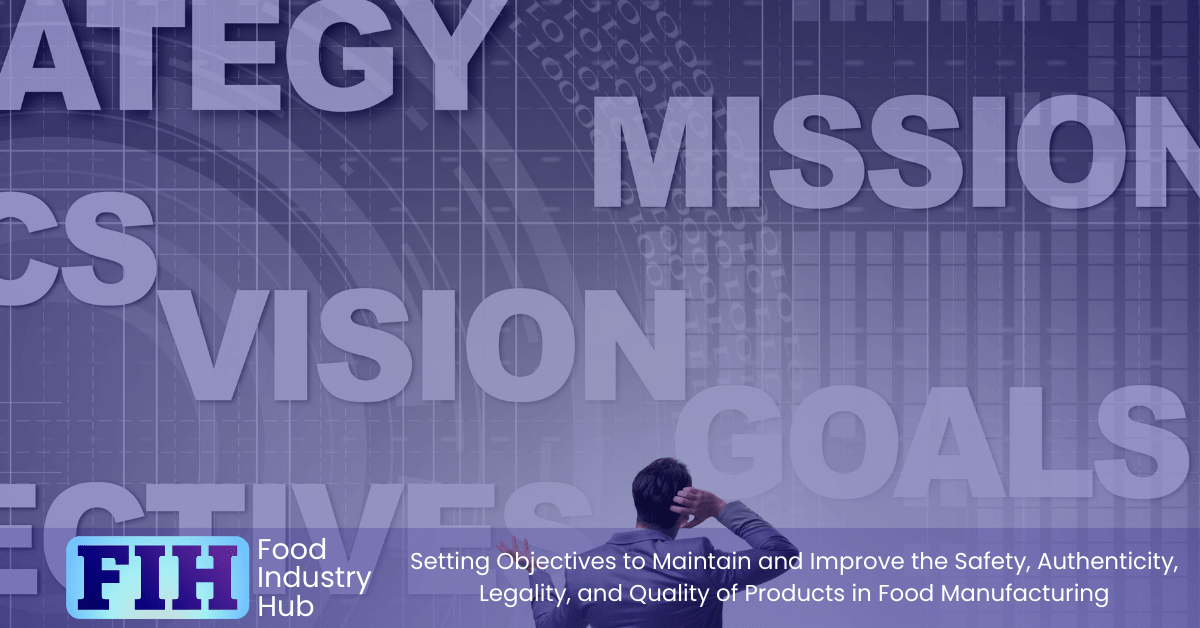
Well defined objectives to maintain and improve the safety, authenticity, legality, and quality of products is a key step that should form the basis for all operational decision-making and should facilitate challenges as to success or failure to meet targets.
Objectives represent the destination that the business is driving towards, and performance metrics applied to the organisation’s objectives should provide a clear narrative over whether the objectives have been achieved, as well as facilitating management interventions for optimisation and improvement.
Further Resources
Food Industry Hub serves the food industry with a range of digital resources for the benefit of both commercial food manufacturers and food industry professionals.
For food manufacturers, we offer integrated management systems that give every user a direct interface with your QMS.
For food industry professionals, we provide an extensive signposting service in addition to informational content we hope you’ll find useful as you face new professional challenges. We have very ambitious plans to expand the range of services offered, and currently present informational content on management, safety and quality, food safety and quality culture, and professional success.