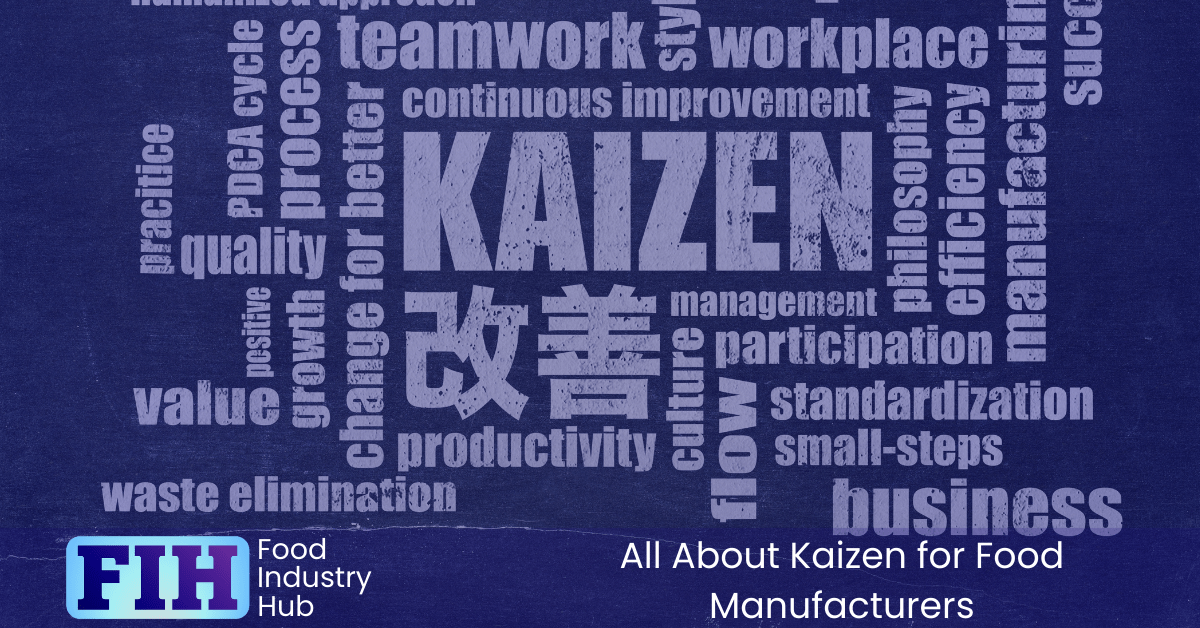
All About Kaizen for Food Manufacturers

The Food Industry Hub Blog

Food Industry Hub blog

The Food Industry Hub blog includes practical discussion for food manufacturing professionals across technical, cultural, management and professional themes.

This post is part of the category:

Introduction

Food manufacturers face increasing pressure to improve efficiency and quality while reducing costs. In today’s competitive market, finding ways to optimise processes and enhance productivity is crucial.

That’s where Kaizen comes in. This continuous improvement methodology has been proven to make a significant impact in the food manufacturing industry. But what exactly is Kaizen, and how can it benefit your organisation?

Stay tuned as we explore all aspects of Kaizen for food manufacturers, from its principles and tools to overcoming challenges. Get ready to take your food manufacturing processes to the next level with Kaizen.

As we dive into the topic, you’ll be interested to know that Food Industry Hub offers integrated management systems for food manufacturers, which you can use to strengthen your assurance processes.

Table of Contents

Key Takeaways

  • Kaizen is a Japanese philosophy that focuses on continuous improvement in all aspects of business, including manufacturing processes.
  • Implementing Kaizen principles in the food manufacturing industry can lead to improved efficiency, reduced waste, and increased productivity.
  • Kaizen encourages employee involvement and empowerment, creating a culture of continuous improvement and fostering innovation.
  • Key tools and techniques for implementing Kaizen in food manufacturing include Gemba walks, the 5 Whys technique, value stream mapping, the PDCA cycle, and standardised work.

What Is Kaizen?

What exactly is Kaizen and how can it benefit food manufacturers?

Kaizen is a Japanese philosophy that focuses on continuous improvement in all aspects of business, including manufacturing processes. By implementing Kaizen principles, food manufacturers can streamline their operations, reduce waste, and increase efficiency. This can lead to improved quality control, lower production costs, and shorter lead times.

Kaizen encourages employees to identify and address problems or inefficiencies in real-time, fostering a culture of continuous improvement. It emphasises the importance of small, incremental changes that can have a significant impact over time.

Importance of Kaizen

Implementing Kaizen principles is very helpful for food manufacturers in order to optimise their operations and achieve continuous improvement.

Kaizen, which focuses on small, incremental changes, allows food manufacturers to identify and reduce waste in their processes, leading to increased efficiency and productivity.

By implementing Kaizen, manufacturers can improve product quality, reduce lead times, and enhance customer satisfaction.

Additionally, Kaizen encourages employee involvement and empowerment, creating a culture of continuous improvement and fostering innovation within the organisation.
Kaizen for Food Manufacturing Businesses

Sign up for the Food Industry Hub Mail Service

Receive Food Industry Hub updates, resources, articles, tools and service developments direct to your inbox.

Each update helps you stay connected with new and relevant Food Industry Hub content, with links back to resources you may want to read, use or revisit.

Benefits of Implementing Kaizen in Food Manufacturing

By implementing Kaizen in food manufacturing, you can reap numerous benefits that will positively impact your operations and drive business growth.

One of the key benefits is improved efficiency. Kaizen encourages continuous improvement and optimisation of processes, leading to reduced waste, increased productivity, and shorter lead times. This can result in cost savings and improved customer satisfaction.

Another benefit is better quality control. Kaizen emphasises the identification and elimination of defects, ensuring that your products consistently meet high standards. This can enhance your brand reputation and customer loyalty.

Kaizen also promotes employee engagement and empowerment. By involving your workforce in problem-solving and decision-making, you can foster a culture of continuous learning and improvement. This not only boosts morale but also encourages ownership.

Ultimately, implementing Kaizen in food manufacturing can help you achieve sustainable growth and stay competitive.

Key Principles of Kaizen

To effectively implement Kaizen in food manufacturing, it’s important to understand and apply its key principles. These principles provide a framework for continuous improvement and can help food manufacturers achieve operational excellence.

The first principle is to focus on customer satisfaction. By understanding the needs and preferences of your customers, you can continuously improve your products and processes to meet their expectations.

The second principle is to empower employees. By involving your workforce in decision-making and giving them the authority to make changes, you can tap into their knowledge and creativity to drive improvements.

The third principle is to embrace a data-driven approach. By collecting and analysing data, you can identify areas for improvement and make informed decisions.

Finally, the fourth principle is to promote teamwork and collaboration. By fostering a culture of collaboration, you can encourage cross-functional teams to work together towards common goals.

Kaizen Tools and Techniques for Process Improvement

One effective way to drive process improvement in food manufacturing is by utilising Kaizen tools and techniques. These tools and techniques are designed to help identify and eliminate waste, improve productivity, and enhance overall efficiency in the manufacturing process.

Gemba Walks

A Gemba Walk is a workplace walkthrough intended to observe employees, find out about activities being undertaken, and provide firsthand understanding of operational processes. When implementing Gemba Walks as part of your continuous improvement strategy, your focus shifts to observing processes firsthand on the ground level. By physically going to where the work is being done, you gain valuable insights into inefficiencies and opportunities for optimisation.

During these walks, engage with employees, ask questions, and listen attentively to their feedback. Direct observation allows you to understand the current state of operations, identify bottlenecks, and witness workflow dynamics. Take notes, capture data, and use this information to drive informed decisions for improvement.

Gemba Walks promote a culture of transparency, collaboration, and problem-solving, empowering you to make impactful changes that enhance productivity and quality at the source.

Small, Incremental Improvements

Engage in making small, incremental improvements consistently to drive ongoing progress and enhance overall efficiency. By focusing on making minor adjustments regularly, you can steadily enhance processes, reduce waste, and boost productivity.

Start by encouraging team members to identify and address small issues that hinder efficiency. These could include simplifying a task, streamlining communication channels, or organising workspaces for better flow. Implementing these incremental changes allows for continuous enhancement without disrupting daily operations.

Empowering Workers

How can workers be empowered to enhance their contributions and drive innovation within the organisation?

Empowering workers involves building a culture where employees feel valued, respected, and encouraged to voice their ideas. Encourage open communication channels where employees can share suggestions and feedback freely.

Provide opportunities for training and skill development to help them excel in their roles and contribute more effectively.

Delegate decision-making authority to frontline workers, allowing them to make real-time improvements and take ownership of their work processes.

Recognise and reward employees for their contributions, motivating them to continue striving for excellence.

Standardisation and Simplification

Standardisation involves creating uniform methods for completing tasks, ensuring consistency and reducing errors. By establishing clear guidelines and protocols, you can minimise variations in processes, making it easier to identify and address inefficiencies.

Simplification, on the other hand, involves eliminating unnecessary steps or complexities in workflows. By breaking down intricate processes into more manageable components, you can improve clarity and speed up operations.

Standardising and simplifying procedures not only make tasks easier to understand but also pave the way for continuous improvement by providing a solid foundation for future enhancements. This approach fosters a culture of efficiency and effectiveness within your organisation.

Steps to Successfully Implement Kaizen in Your Food Manufacturing Facility

After familiarising yourself with the various Kaizen tools and techniques for process improvement in food manufacturing, it’s important to understand the steps required to successfully implement Kaizen in your own food manufacturing facility.

The first step is to create a culture of continuous improvement by fostering open communication and encouraging employee involvement.

Next, identify and prioritise areas for improvement by analysing data and gathering input from employees.

Then, develop a detailed plan of action, including specific goals and timelines.

Implement the plan by assigning responsibilities to team members and providing necessary resources and training.

Regularly monitor progress and make adjustments as needed.

Finally, celebrate successes and recognise the efforts of employees to maintain motivation and sustain the Kaizen mindset.
Kaizen in Food Manufacturing

Creating a Kaizen Culture in Your Organisation

In order to create a Kaizen culture in your organisation, it’s essential to foster a mindset of continuous improvement among all employees. This means encouraging everyone to constantly seek ways to improve processes, identify waste, and suggest innovative solutions.

Start by communicating the importance of Kaizen and its benefits to your team. Provide training and resources to help employees understand the principles and methodologies of Kaizen. Encourage them to actively participate by sharing their ideas and suggestions for improvement.

Recognise and reward individuals and teams who contribute to the Kaizen culture. Additionally, establish regular review meetings to evaluate progress and discuss new improvement opportunities.

Overcoming Challenges in Adopting Kaizen for Food Manufacturers

Don’t let challenges deter you from adopting Kaizen for food manufacturing – embrace them as opportunities for growth and improvement. While implementing Kaizen in your food manufacturing processes, you may encounter challenges, but these shouldn’t discourage you.

One common challenge is resistance to change from employees who may be hesitant to embrace new methods and processes. To overcome this, it’s important to communicate the benefits of Kaizen and involve employees in the decision-making process.

Another challenge is the lack of resources or budget constraints. In such cases, you can start small and gradually implement Kaizen principles, focusing on areas that can generate quick wins.

Maintaining momentum and sustaining the Kaizen mindset may be challenging, but by providing continuous training, feedback, and support, you can ensure long-term success.

Sustaining Continuous Improvement with Kaizen

As you sustain continuous improvement with Kaizen in your food business, it’s crucial to foster a culture of ongoing learning and collaboration among your employees.

This culture of continuous improvement should permeate all levels of your organisation, from top management to frontline workers. Encourage your employees to constantly seek opportunities for improvement and provide them with the necessary support and resources.

Emphasise the importance of open communication and feedback, creating an environment where ideas and suggestions are welcomed and valued. Regularly hold team meetings and training sessions to share best practices, address challenges, and celebrate successes.

In Summary

Congratulations! You have now discovered the power of Kaizen in the food manufacturing industry. By implementing this continuous improvement philosophy, your organisation can unlock a world of benefits, from increased efficiency to enhanced customer satisfaction.

Like a well-oiled machine, your processes will flow smoothly, ensuring the highest quality products. Embrace the Kaizen culture and watch your organisation thrive.

The journey may have its challenges, but with determination and perseverance, success is within your grasp.

Further Resources

Food Industry Hub serves the food industry with a range of digital resources for the benefit of both commercial food manufacturers and food industry professionals.

For food manufacturers, we offer integrated management systems that give every user a direct interface with your QMS.

For food industry professionals, we provide an extensive signposting service in addition to informational content we hope you’ll find useful as you face new professional challenges. We have very ambitious plans to expand the range of services offered, and currently present informational content on management, safety and quality, and professional success.
Continuous Improvement

Continuous Improvement

Continuous improvement represents a foundational approach to operational excellence that has transformed industries worldwide over recent decades. This systematic methodology for enhancing products, processes, and services through incremental advancements has evolved from its origins in post-war manufacturing to become an essential business practice across all sectors. The evidence demonstrates that organisations implementing robust continuous improvement frameworks typically experience significant benefits, including enhanced productivity, improved quality, reduced costs, and strengthened competitive positioning. However, successful implementation requires overcoming substantial challenges related to leadership commitment, cultural integration, and sustained organisational focus. This research examines the multifaceted nature of continuous improvement, analysing its conceptual foundations, methodological frameworks, implementation approaches, and organisational impact in contemporary business environments.

A Practical Guide to Kaizen

A Practical Guide to Kaizen

In food manufacturing, finding ways to improve efficiency, maintain quality, and reduce waste is critical to staying competitive. This is where Kaizen, a Japanese philosophy of continuous improvement, offers a compelling solution. By focusing on small, incremental changes rather than sweeping overhauls, Kaizen enables food manufacturers to tackle challenges systematically while fostering a culture of collaboration and innovation. Whether you’re aiming to streamline production lines, enhance food safety standards, or reduce operational costs, Kaizen provides a practical and proven framework for achieving sustainable improvements.

The beauty of Kaizen lies in its emphasis on people-driven solutions. By involving employees at every level and encouraging them to identify inefficiencies and suggest improvements, businesses can unlock valuable insights that might otherwise go unnoticed. Techniques like the 5S methodology, Gemba Walks, and Poka-Yoke are integral to Kaizen and particularly well-suited to the complexities of food manufacturing. These tools empower organisations to not only optimise processes but also build stronger teams and foster a shared commitment to excellence. For food manufacturers seeking to navigate today’s challenges and seize opportunities for growth, implementing Kaizen offers a path to long-term success.

Values-Driven Leadership in Food Manufacturing

Values-Driven Leadership in Food Manufacturing

IntroductionMaintaining a strong commitment to food safety and quality has become more important than ever. As a senior leader, you have the unique ability to shape the culture of your organisation and influence the values that guide your team. When you prioritise...

Root Cause Analysis in Food Manufacturing

Root Cause Analysis in Food Manufacturing

Imagine you’re a food manufacturer facing recurring product defects. You’re firefighting the symptoms, but what if you could tackle the root of the problem instead? That’s where Root Cause Analysis (RCA) comes into play. It’s a proactive method to identify, address and, importantly, prevent issues from reoccurring. It’s not just about fixing problems, it’s about creating a seamless, efficient operation. Intrigued about how RCA can revolutionise your manufacturing process? Stay with us as we unpack this crucial tool further.

Six Sigma for Food Manufacturers

Six Sigma for Food Manufacturers

IntroductionAs a food manufacturer, you're likely always on the hunt for ways to enhance your production processes. Have you ever considered the Six Sigma methodology? This technique, focused on reducing defects and increasing efficiency, could drastically transform...

Management Concepts & How They Apply in Food Manufacturing

Management Concepts & How They Apply in Food Manufacturing

Mastering a range of management concepts and approaches is essential for operational efficiency and sustained growth. When you consider the intricate web of factors influencing the food industry, from fluctuating consumer demands to evolving regulatory requirements, how can these methodologies be strategically leveraged to navigate the unique challenges faced by food manufacturers?

This post will introduce you to a collection of management concepts and approaches which you can apply to different circumstances and challenges for your food business.

Total Quality Management (TQM)

Total Quality Management (TQM)

Implementing TQM in your food manufacturing processes can lead to a culture of continuous improvement, where every employee is committed to delivering products that meet or exceed customer expectations. By focusing on customer satisfaction, TQM helps food manufacturers identify areas for improvement, streamline processes, and reduce waste, ultimately leading to higher quality products.

Total quality management promotes a collaborative work environment where employees are encouraged to communicate openly, share ideas, and work together towards common quality goals. This teamwork not only improves morale and employee satisfaction but also fosters innovation and creativity, leading to new ways to enhance product quality and efficiency.

Management and Leadership: Approaches and Techniques

Management and Leadership: Approaches and Techniques

Management and leadership are expansive topics. In this post, will explore a range of approaches and techniques that you might find helpful as a manager in the food industry. The intention is to introduce you to a variety of management strategies, without overwhelming the subject with fine detail.
Read on for an introduction into a collection of managerial tactics and strategies That you can build on to establish a comprehensive and thoughtful approach to management in your food manufacturing business.

Management Versus Leadership: What Every Food Manufacturer Should Know

Management Versus Leadership: What Every Food Manufacturer Should Know

What exactly sets management apart from leadership? How can you leverage both to steer your organisation towards growth and innovation?

In this post, we’ll look at the characteristics of management versus leadership, and how the two skills compliment each other for an effective and engaged organisational culture.

How To Make Yourself More Approachable as a Manager in The Food Industry

How To Make Yourself More Approachable as a Manager in The Food Industry

Did you know employees feel more engaged and productive when they have approachable managers?

As a manager in the food manufacturing industry, it is crucial for you to establish a strong connection with your team in order to foster a positive work environment and drive success.

But how can you make yourself more approachable?

In this post, we will explore practical strategies and techniques that will not only enhance your leadership skills but also create a supportive atmosphere where your employees feel comfortable sharing their ideas, concerns, and feedback.

Maslow’s Hierarchy of Needs: Understanding Motivational Drivers to Encourage Engagement

Maslow’s Hierarchy of Needs: Understanding Motivational Drivers to Encourage Engagement

Motivation is a multifaceted and fascinating concept that drives human behaviour, but have you ever wondered what truly motivates individuals in the workplace?
Enter Maslow’s Hierarchy of Needs, a renowned framework that explores the various levels of human needs and their impact on engagement. From basic physiological necessities to the pursuit of self-actualisation, this hierarchy provides valuable insights into what truly drives individuals to excel.
But how can understanding these motivational drivers benefit both employees and managers? And what potential drawbacks should be acknowledged?

5 Tips for Managers in The Food Manufacturing Industry

5 Tips for Managers in The Food Manufacturing Industry

In this post, we will explore five tips to help bolster your managerial outlook.
From prioritising food safety practices to staying updated with industry regulations, these tips will not only help you maintain a smooth operation but also ensure the success and growth of your team and your business.

Plan Do Check Act: Achieving the Outcomes Needed for Your Food Manufacturing Business

Plan Do Check Act: Achieving the Outcomes Needed for Your Food Manufacturing Business

We all have targets and objectives to meet, but sometimes it can seem challenging to achieve the outcomes needed.
This is where the PDCA (Plan Do Check Act) methodology comes into play. It offers a systematic approach to achieving the management results needed for your food manufacturing business. With PDCA, you can continuously improve processes, monitor performance, and make data-driven adjustments to ensure compliance and quality control.

Deadline Disasters – Why Food Manufacturers Need Project Management Tools

Deadline Disasters – Why Food Manufacturers Need Project Management Tools

Receiving task requests from a variety of sources can make it difficult to manage individual workloads because it can lead to confusion over which tasks are a priority, duplication of effort, and difficulty in tracking progress. This can make it challenging to ensure that all tasks are completed on time and to the appropriate standard. Additionally, without a clear system in place for managing and assigning tasks, it can be difficult to ensure that all workers are utilising their time and skills effectively. In this post, we’ll look at the applications for project management software in food manufacturing, and the range of benefits it can bring.

Digital Revolution: How Software is Reshaping Food Industry Management

Digital Revolution: How Software is Reshaping Food Industry Management

Food manufacturing software can really transform efficiency across an organisation. Digital systems bring connectivity for communication and visibility in ways that can’t be achieved using offline systems. In this post, we’ll explore some of the ways software is revolutionising operational and managerial processes in the food manufacturing industry.

Development of the Food Safety and Quality Culture for Food Manufacturing Businesses

Development of the Food Safety and Quality Culture for Food Manufacturing Businesses

Food safety and quality culture is among the most important objectives for food manufacturing businesses to focus on.

To put the significance of culture into perspective, you can think of it as an invisible management system that sits alongside your documented processes. In effect, the documented management system provides structure and instructions for what top-down leadership has determined should happen, and culture determines whether or not the documented food safety and quality manual is implemented.

Beyond that, a strong culture of food safety and quality can mitigate for deficiencies in the documented management systems. If a particular scenario isn’t directly accommodated for by the documented management system, then the values instilled into people through the food safety and quality culture will still be protective of food safety and quality outcomes.

Establishing Responsibilities and Management Authority in Food Manufacturing

Establishing Responsibilities and Management Authority in Food Manufacturing

Structured management is essential in food manufacturing. Establishing responsibilities and management authority is an integral part of creating a successful organisational structure. It ensures that decision-making power is distributed in an effective manner, while also providing clear accountability and escalation processes. In food manufacturing, an effective organisational structure should include a clear chain of command and clearly defined roles.

How to Proactively Demonstrate Senior Management Commitment

How to Proactively Demonstrate Senior Management Commitment

Food manufacturing is an ever-changing industry that requires strong commitment and effort from senior management to ensure high quality, safe products are produced. Quality, safety, authenticity and compliance are key factors for success in this sector. To be successful, it is important that senior management demonstrate their genuine commitment to the business through resource investment and ethical practices. This article will discuss how senior management can proactively demonstrate their commitment to food manufacturing in order to ensure high standards are maintained and the business remains viable and competitive.

Setting Objectives to Maintain and Improve the Safety, Authenticity, Legality, and Quality of Products in Food Manufacturing

Setting Objectives to Maintain and Improve the Safety, Authenticity, Legality, and Quality of Products in Food Manufacturing

The highest responsibility of any food manufacturer is to uphold the safety, authenticity, legality, and quality of its products. This is fundamental to fulfilling the expectations of customers and consumers.

To this end, food manufacturers should set clear objectives to maintain and improve assurance process is and quality outcomes.

These objectives should be measurable and ‘smart’ in order to promote success in maintaining or improving product safety, authenticity, and legality. This article will provide an overview of how setting objectives can help food manufacturers to achieve optimal standards for their products and processes.

Eliminating Blame from The Culture in Your Food Manufacturing Business

Eliminating Blame from The Culture in Your Food Manufacturing Business

Eliminating blame from the culture of your food manufacturing business can be challenging to achieve. But having a constructive approach to reporting and analysing mistakes can lead to more positive outcomes for everyone involved.

This post will discuss how to create an atmosphere of trust, open communication, and continuous improvement in order to eliminate the culture of blame in your food manufacturing business.

Making Use of Persuasion Techniques for Management Success

Making Use of Persuasion Techniques for Management Success

Persuasion is an invaluable tool for a successful manager. Through the use of persuasive techniques, effective managers can generate team collaboration, engagement, and buy-in in order to achieve success. In this article we will examine how persuasion, defined as...

Begginer’s Guide to Management in The Food Industry

Begginer’s Guide to Management in The Food Industry

The food manufacturing industry can be a challenging landscape for first-time managers. Juggling the demands of personnel management, production processes, and tight deadlines is enough to overwhelm even experienced professionals. Thankfully, there are key steps that...

Food Industry Hub blog

The Food Industry Hub blog includes practical discussion for food manufacturing professionals across technical, cultural, management and professional themes.

This post is part of the category:

Stay connected with Food Industry Hub

Receive Food Industry Hub updates, resources and practical content for food manufacturing businesses and professionals.

Stay informed about new resources, articles, tools and Food Industry Hub service developments.