10 Ways To Improve Your Food Safety and Quality Culture

The Food Industry Hub Blog

Food Industry Hub blog

The Food Industry Hub blog includes practical discussion for food manufacturing professionals across technical, cultural, management and professional themes.

This post is part of the category:

Introduction

Food safety and quality culture can be a difficult thing to address because of the intangible nature of the topic. In this post, we offer actionable suggestions for initiatives that you can use to develop a culture of food safety and quality.

This post is part of a collection we’ve put together to explore the topic of food safety and quality culture, and you can explore the topic in more detail by browsing the related content.

Table of Contents

1 Update Recruitment Processes

Everything from job adverts, interview questions, and contracts (with associated reward structures) can be adjusted in favour of selection of candidates whose values align with the organisation’s food safety and quality ideals.
Update Recruitment Processes

2 Orient Accountability Around Values, Not Authorities

If you’re enforcing behaviours by appealing to an authority figure (such as an auditor or a manager), then all of the compliance motivation depends on the avoidance of undesired outcomes (like non-conformances or punishment/consequences). This is inherently flawed, because the enforcement structure fluctuates depending on how likely they think it is that an auditor or manager will scrutinise what they’re doing. Threats are only effective when they’re enforced.

Conversely, if you can motivate people by appealing to their sincerely-held values then there is usually no need to enforce compliance.
Orient accountability around values, not authorities

3 Redevelop Internal Feedback Mechanisms

Training, education, positive reinforcement, and realignment of individual and organisational interests can be very constructively used to correct attitudes and behaviours. Threats and punishment rarely have any substantial benefit for behaviour improvement, but have the side effect of eroding the employer/employee relationship.

Many organisations organically arrive at a punitive feedback structure – with a disciplinary procedure which can be activated at the click of a finger, accompanied by a personal development plan which grudgingly comes into play once a year as part of an appraisal process.

If you examine the feedback mechanisms at your business, you may find that there is a lot of variation between different managers and departments/functions. Organisationally, there could be a major benefit to training managers on how to appropriately enact the various interventions available to them – bringing a sense of direction and predictability to the way employees are engaged with.
Redevelop Internal Feedback Mechanisms

Sign up for the Food Industry Hub Mail Service

Receive Food Industry Hub updates, resources, articles, tools and service developments direct to your inbox.

Each update helps you stay connected with new and relevant Food Industry Hub content, with links back to resources you may want to read, use or revisit.

4 Training and Development

Training, in of itself, would improve competence – but not necessarily culture.

That said, there are 2 ways that training can be used to develop a culture of food safety and quality:

Training on food safety and quality topics
It’s easy to motivate actions/behaviours, as long as those actions/behaviours fall in line with people’s attitudes and beliefs. Training that directly educates participants about food safety and quality practices and rationales will substantially improve the belief system throughout your organisations’ food safety and quality culture. People will take actions that they believe will uphold food safety and quality values, based on the education they receive.

Training as a reward system
If you find out the career aspirations for individuals working throughout your business, you can offer training with a view to developing them into their next aspirational career step. Part of this can directly address food safety and quality objectives, but there is probably a stronger secondary advantage in building a culture or reciprocity. If employees’ own needs are served as they act on behalf of the business’ interests, then that’s a situation that aligns both individual and organisational interests. This creates an environment where both parties can be sympathetic to each other’s motivations and interests.
Training and Development

5 – Eliminate Blame

You can’t have a management system that consists of blame and punishment and also have a culture of safety and quality. You’d never get open communication of risk information, and no-one would ever voluntarily admit a mis-step for fear of being punished. You can’t improve processes under those circumstances.

Think carefully, as well, about how you use terms such as ‘accountability’. In the way you apply the word, what sort of emotions does it trigger?

Positivity, ownership, recognition, empowerment?

Punishment, failure, blame, consequences?

There’s an apparent dissonance between promoting accountability and eliminating blame – but there really needn’t be. Make people accountable to food safety and quality values, then support them in upholding those values. No blame or punishment needed.
Eliminate Blame

6 Carry Out a Values Analysis

Carry out a values analysis across all stakeholder groups and determine how well the values of individuals and/or groups align with the organisation’s ideals.

Speak openly and negotiate the way competing interests should be serviced.
You can’t dictate to people what their values should be, but you can understand their opening position and try to persuade them that there is something important to protect by making a priority of food safety and quality concerns.
In the same way, you can gain an understanding of competing interests, and how they fit into the system of priorities the business has to tend to.

A well-implemented values analysis can be a really good opportunity to align individuals and groups within your organisation around a unifying set of values/ideals.
Carry Out a Values Analysis

7 Design User-Oriented Systems

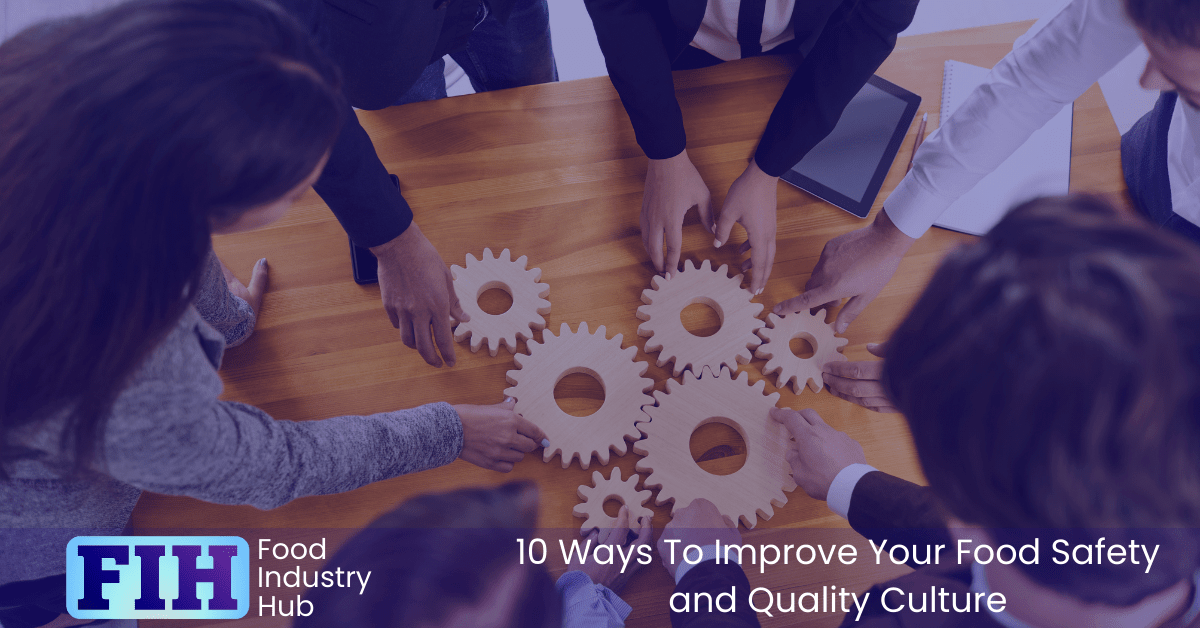
The reason we position handwash stations at the factory entrance is that it makes it easy and convenient for people to wash their hands as they enter the factory.

Do that for every system you introduce. Make it easy and convenient for people to comply with managerial expectations. If you can make it so that it’s easier and more convenient to comply than to non-comply, you pretty much cracked the code.

When we talk about culture, we have to refer to actions and behaviours as proxy metrics – so you can’t measure or assess ‘culture’, but you can relatively easily measure and assess actions/behaviours. Interestingly, there’s a post-rationalisation cognitive bias that promotes values as a consequence of behavioural compliance – because it’s easy for someone to rationalise to themselves that they now perform a certain action because it’s valuable or important, rather than simply being convenient or demanded by management. If you can introduce compliance systems that promote desirable behaviours, you can actually end up with improvements in attitude, too.
Design User-Oriented Systems

8 Demonstrate Commitment

There’s a saying: actions speak louder than words. This is really visceral. Managers can say what their values are, but people will believe values expressed by actions are sincerely held.

A financial investment can be a really effective way to signal sincerity of values. Find a way of deploying a bit of budget on something that is very visible and highly associated with food quality and safety.
It doesn’t really matter if you invest in training or analytical equipment – as long as you make a really genuine gesture of commitment to food safety and quality ideals.

This kind of suggestion can seem objectionable, because many management teams hold the expectation that culture change should be divorced of financial commitment. Attitudes and beliefs are free.
The thing is, if there is any scepticism over the organisation’s commitment to food safety and quality values, it results in a massive reduction in the likelihood of success in food safety and quality culture development initiatives. You could consider a display of commitment backed up by financial outlay as being a mitigator against that scepticism.

A wedding ring is an effective signalling method because of its cost. I am sincerely committed to this, and my commitment is substantially demonstrated through the upfront sacrifice/outlay. A wedding ring without the cost would be a far less substantial gesture. It’s the same with management commitment – so you need to go beyond making claims about values, and use actions to substantiate commitment.
Demonstrate Commitment

9 Get People Personally Invested

Align people’s personally held values with the business’ food safety and quality ideals.

Remind employees that their friends and family may be among those buying the products. Make safety and quality immediately-relevant concerns.

If you made a company shop available to your employees, would they be enthusiastic about engaging?

People will act on values they sincerely hold to be important. Make sure food safety and quality are important to them.

Get People Personally Invested

10 Open-Up Communication

Don’t rely solely on confidential reporting systems. Make sure there is genuine 2-way communication across different tiers of authority.

Confidential reporting systems can be used to offer employees a safe way to report information and ideas, while preserving anonymity. Useful, sure – but only a small aspect of overall communication.

There is a wide range of options that can be introduced, from huddle meetings, presence of management on the factory floor, ideas/suggestions competitions, internal forums (including employee resource groups), 360 review processes (including feedback for managers from subordinates), etc.

Organisations that value and prioritise communication across different authority tiers benefit from actionable insights at all levels throughout the business. There’s a direct operational advantage as well as a cultural advantage.

Open-Up Communication

In Summary

There’s a wide range of systematic and managerial interventions that can be used to promote a culture of food safety and quality throughout your business.

Consider all of the structural influences that act on your internal culture and adapt them where needed. Culture change can take a long time to achieve, so enduring systemic interventions are probably the best way to achieve a long-term successful outcome.
Improve your food safety and quality culture

From The Food Industry Hub Knowledge Centre

Featured pages from The Food Industry Hub Knowledge Centre:

Know: Food Safety and Quality Culture

Know: Food Safety and Quality Culture Development Plan

Further Resources

Food Industry Hub serves the food industry with a range of digital resources for the benefit of both commercial food manufacturers and food industry professionals.

For food manufacturers, we offer integrated management systems that give every user a direct interface with your QMS.

For food industry professionals, we provide an extensive signposting service in addition to informational content we hope you’ll find useful as you face new professional challenges. We have very ambitious plans to expand the range of services offered, and currently present informational content on management, safety and quality, and professional success.
Identifying and Ranking Values for Culture Alignment

Identifying and Ranking Values for Culture Alignment

What truly defines your company’s culture? While policies, procedures, and training play a role, the foundation of a strong food safety and quality culture lies in the values your business upholds. These values shape the way decisions are made, the priorities that are protected, and the attitudes employees develop toward their work. However, in a food manufacturing environment, competing priorities—such as production efficiency, cost control, and commercial performance—can create tension with food safety and quality commitments. Without a clear structure for resolving these conflicts, the company’s culture risks becoming inconsistent, reactive, or misaligned with its intended priorities.

To create a strong, values-driven culture, businesses must first identify the full range of values that influence their operations—including those related to food safety, quality, financial sustainability, and employee well-being. Then, they must rank these values in a hierarchy that provides clarity when conflicts arise. A well-defined ranking ensures that when priorities compete, there is no ambiguity about which values take precedence. This not only strengthens decision-making at all levels but also provides employees with the confidence to act in alignment with the company’s long-term commitments.

Food Safety and Quality Culture: Fundamental Principles

Food Safety and Quality Culture: Fundamental Principles

IntroductionCreating a culture of food safety and quality is essential for any food manufacturing business aiming to maintain high standards, protect consumer health, and uphold its reputation. It involves more than just meeting regulatory requirements; it requires a...

Values, Attitudes, and Behaviours: A Culture of Safety and Quality

Values, Attitudes, and Behaviours: A Culture of Safety and Quality

IntroductionThe culture of safety and quality within your organisation is not just dictated by policies and procedures; it's shaped by the values you espouse, the attitudes you cultivate, and the behaviours you reward. So how do you ensure that the values you've put...

Discussion: Food Safety and Quality Culture

Discussion: Food Safety and Quality Culture

IntroductionOn Friday 30th August 2024, Food Industry Hub’s Duncan Lacey joined Bryan Armentrout on The Food Leadership Group Food Safety Chat Live! to discuss food safety and quality culture. You can watch a recording of the chat here, and the transcript is shown...

Using Peer Pressure for Food Safety and Quality Culture Development

Using Peer Pressure for Food Safety and Quality Culture Development

IntroductionConsider the power of positive peer pressure in shaping the culture of food safety and quality in your organisation. You've seen how it can sway behaviours in other aspects, but have you ever considered harnessing it to encourage adherence to food safety...

Ecosystem Influences on Food Safety and Quality Culture

Ecosystem Influences on Food Safety and Quality Culture

In a food manufacturing business, the ecosystem surrounding food safety and quality is a multifaceted web of influences. From suppliers ensuring top-notch materials to consumers demanding transparency, each stakeholder adds a crucial layer to the culture. But have you considered the hidden impacts of external factors like market trends and global supply chains on this delicate balance? These unseen forces can shape the very foundation of how food safety and quality are perceived and upheld within the industry.

The Role of Feedback in Food Safety and Quality Culture

The Role of Feedback in Food Safety and Quality Culture

In the complex landscape of food manufacturing, the influence of social feedback on shaping food safety and quality culture cannot be overstated. Your organisation’s success in maintaining high standards hinges on how effectively social interactions reinforce desired behaviours and values. From fostering a sense of responsibility to driving continuous improvement, the dynamics of social feedback can significantly impact the overall ethos of your workplace. But how exactly does this interplay unfold, and what strategies can be employed to harness its potential for enhancing food safety and quality practices within your business?

Food Safety Culture: An Organisational Walkthrough

Food Safety Culture: An Organisational Walkthrough

Food safety and quality culture is not separate to organisational systems or business structure. In reality, organisational culture is a characteristic -and expression- of the organisation, and manifests throughout all levels.
In this post, we’ll explore the interplay of organisational constructs and the food safety and quality culture throughout a food manufacturing business.
Read on to find out the influences of different organisational systems on food safety culture, how to influence and exert control over your food safety and quality culture, and How the culture of food safety and quality exists within the bigger picture of your organisation.

Applying Metrics for Food Safety and Quality Culture Measurement

Applying Metrics for Food Safety and Quality Culture Measurement

Are you clear on how to measure/assess the maturity of your food safety and quality culture?

It can seem hard to apply objective metrics to culture, but there are ways to substantiate improvement.

Read here for examples of how you can apply metrics for food safety and quality culture measurement.

A Comprehensive Guide to Food Safety and Quality Culture Improvement

A Comprehensive Guide to Food Safety and Quality Culture Improvement

In this post, we’ll discuss the nature of food safety and quality culture and how it’s defined. We’ll touch on measurement/evaluation and how best to assess your food safety and quality culture. We’ll also go on to explore some of the ways you can improve and develop your culture of food safety and quality.

How To Achieve Culture Change in Your Food Manufacturing Business

How To Achieve Culture Change in Your Food Manufacturing Business

So, you’ve noticed that your food manufacturing business could use a culture revamp. But how do you actually make that happen?
It’s not just about setting goals and hoping for the best. There’s a strategic process involved that requires commitment and finesse.
Let’s explore the key steps that will not only transform your organisational culture but also ensure long-term success in this competitive industry.

Leveraging Game Theory Principals to Improve the Food Safety and Quality Culture in Your Food Business

Leveraging Game Theory Principals to Improve the Food Safety and Quality Culture in Your Food Business

In food manufacturing, developing and maintaining mature culture of food safety and quality culture is of the utmost importance. That’s where leveraging game theory principles comes into play. Game theory addresses interactions between individuals and/or groups, so taking advantage of this strategic approach can give you a toolset for influencing those interactions. In turn, this can support your efforts to foster a culture that not only ensures the safety and quality of your products but also enhances the overall efficiency of your operations.

Using Behavioural Sciences to Improve the Food Safety and Quality Culture in Your Food Business

Using Behavioural Sciences to Improve the Food Safety and Quality Culture in Your Food Business

As you stand in your food manufacturing facility, contemplating the intricacies of maintaining a strong food safety and quality culture, you may find yourself wondering if there are ways to improve and enhance the attitudes and behaviours of your employees. The field of behavioural economics holds great promise in offering insights and strategies to achieve just that.

By applying the principles of behavioural sciences, you can create a workplace environment that not only promotes safer food practices but also fosters a culture of excellence and quality assurance. So, how exactly can behavioural economics help you accomplish this?

Quality Management and Food Safety Culture – a Virtuous Cycle

Quality Management and Food Safety Culture – a Virtuous Cycle

A culture oriented toward safety and quality values implies a level of buy-in across the organisation that would serve the intent of the quality management system in a way that mere adherence to procedural requirements cannot approach. The documented food safety and quality management system serves to organise and instruct, while a mature culture of safety and quality can fulfil the goals of the management system even in the absence of explicitly defined instructions and processes.

In this post, we will explore the advantages of having a well-developed and dependable food safety management system and the relationship between the food safety and quality management system and a food business’ food safety and quality culture.

Data Processing for Food Safety and Quality Culture Development

Data Processing for Food Safety and Quality Culture Development

There’s a lot about culture that seems very subjective and removed from objective data, but data interactions can be among the most powerful tools organisations have when making strategic interventions to their food safety and quality culture. This post explores data-handling by organisations, looking at collecting, assessing, and reacting to data; and some of the effects that this can have of food safety and quality culture development.

Building a Strong Quality Culture with a Systematic Approach

Building a Strong Quality Culture with a Systematic Approach

Many compliance standards now include requirements for food businesses to demonstrate the development and improvement of their food safety and quality culture. This post explores systemic influences on culture and offers suggestions for how to promote your businesses’ food safety and quality culture through systematic interactions.

How To Intentionally Develop a Culture of Food Safety and Quality

How To Intentionally Develop a Culture of Food Safety and Quality

This is intended to provide a framework that you can use to assess and improve your food safety and quality culture. We’ll explore how to align values and encourage their adoption. We’ll also discuss ways to address conflicts for mutual benefit. All of this will lead to a methodology for implementing your food safety and quality culture development plan.

How Food Safety and Quality Culture is Organically Formed

How Food Safety and Quality Culture is Organically Formed

Every organisation has a food safety and quality culture, whether it has been intentionally shaped or allowed to develop organically. In this post, we’ll explore some of the easily overlooked factors that may influence the organic formation of internal culture.

Food Safety and Quality Culture – Prerequisites

Food Safety and Quality Culture – Prerequisites

There are a few conditions that need to be met in order to establish a strong culture of food safety and quality, so in this post we’ll explore some of the success criteria for a mature culture of safety and quality.

Understanding Food Safety and Quality Culture

Understanding Food Safety and Quality Culture

In this post, we’ll look at organisational culture and how food safety and quality culture fits into it. We’ll explore attitudes, behaviours, and interactions with the internal culture. We’ll also address the relationship between food safety and quality culture and compliance with management structures, as well as the significance of culture of food safety and quality performance.

Food Industry Hub blog

The Food Industry Hub blog includes practical discussion for food manufacturing professionals across technical, cultural, management and professional themes.

This post is part of the category:

Stay connected with Food Industry Hub

Receive Food Industry Hub updates, resources and practical content for food manufacturing businesses and professionals.

Stay informed about new resources, articles, tools and Food Industry Hub service developments.